Nine Korean Universities, Zero Rebuttals: The Partnership Fraud Map Keeps Expanding (updated at 2026-03-12T03:57:16Z)
Nine Korean universities — including SNU, Sogang, Ajou, and Hongik — responded to reciprocity audit findings with database deletions and silence. Not one has disputed the methodology. Not one has issued a correction.
In January 2026, Seoul National University — Korea's highest-ranked institution, ranked among the top 40 universities in the world — pulled its international partner database offline. Before it disappeared, it listed Ritsumeikan University (Japan, QS ~250) as a student exchange partner. Ritsumeikan's own exchange database does not list SNU.1
In mid-February 2026, Chung-Ang University (CAU) and Sogang University both took their partner databases offline within roughly a two-week span of each other. CAU's came back after approximately 65 hours. Sogang's did not.
UPDATE: Back Online (after 65 Hours)
— Gender Watchdog (@Gender_Watchdog) February 14, 2026
Chung-Ang University (#11 Global Rank) has reappeared online as of midnight PST (Feb 14).
The Timeline:
1️⃣ Goes Dark: Feb 11
2️⃣ We Expose: Feb 12
3️⃣ Restored: Feb 14
They spent ~2.5 days in the dark. Now the real work begins: We are…
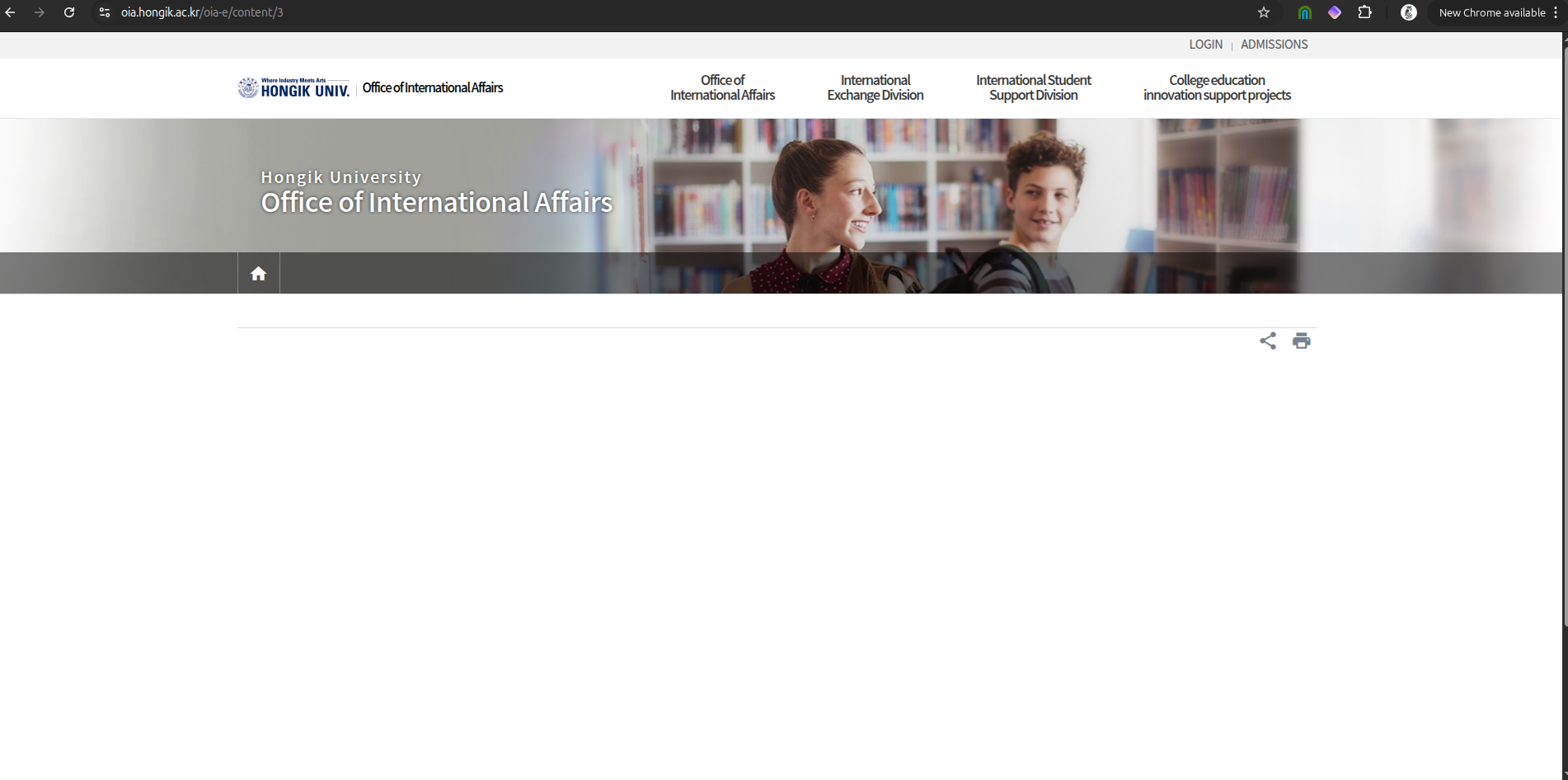
Sometime before March 9, 2026, Hongik University's Office of International Affairs partner page — oia.hongik.ac.kr/oia-e/content/3 — went blank. The Wayback Machine captured it. Gender Watchdog took a screenshot.2 By approximately March 11, it was back online. No statement, no rebuttal.
Sometime before March 10, 2026, Ajou University's partnerships directory — ajou.ac.kr/oia/intro/partnerships.do — went blank. Wayback capture. Screenshot archived.3 Also back online within approximately 48 hours. Also no statement.
Those are the documented database deletions — five institutions, five disappearing acts, five restorations or sustained silences. Three of the five came back online within 48–65 hours. None has disputed the methodology. None has published a counter-audit. None has issued a correction.
But the deletion wave is only half the picture.
Before any database went dark, Gender Watchdog documented specific, named false partnership claims — each confirmed against the named institution's own published database:
Dongguk University listed the University of British Columbia (UBC) as a global partner. After the BC Office of Information and Privacy Commissioner intervened in a Gender Watchdog FOI request, Dongguk silently deleted UBC. In the same scrub, Toronto Metropolitan University was reverted to its dead name "Ryerson University" — retired April 2022. Any institution with a live relationship with TMU would be corresponding with @torontomu.ca addresses. The dead-name reversion documents that Dongguk was copying from expired records, not maintaining active institutional relationships.4 A second Canadian university sent Gender Watchdog a written denial of any active partnership and requested not to be named to journalists or media. Dongguk has not responded to any outreach since April 10, 2025.
Keimyung University (Daegu) listed Fudan University (C9 League / China top-3), Beijing Foreign Studies University (BFSU — the elite diplomatic languages institution), Sun Yat-sen University, and East China Normal University (ECNU) as institutional partners. Manual verification of all four databases: every one of them is absent. Fudan lists SNU, Yonsei, Korea University and others — Keimyung not among them. BFSU lists Hanyang, HUFS, Ewha, Inha, Woosong — no Keimyung. Sun Yat-sen's exchange database — no Keimyung. ECNU explicitly names 11 Korean partners — Keimyung absent.5
Tu Anh, 25, a Keimyung International Commerce graduate, fell to her death on October 28, 2025 fleeing an immigration raid at a car parts factory in Daegu. She was doing factory work because the "Global Degree" had secured her no E-7 professional visa pathway. Only 10% of foreign bachelor's degree holders in Korea obtain an E-7.5
Chungbuk National University (CBNU) has listed Universitas Indonesia (UI) as a formal exchange partner since April 11, 2017. UI's own exchange database, filtered to Republic of Korea, lists SNU, Yonsei, POSTECH, Pukyong, Pusan, Sungkyunkwan, and a dozen others. CBNU does not appear on any page.6 7
Catholic University of Korea claims Universitas Indonesia via its exchange partner API. UI does not list Catholic University of Korea on its exchange partner list or its MOU list — both databases checked, multiple pages.8
Seoul National University, Dongguk University, and Ewha Womans University each list the University of Oslo as an institutional partner. Oslo's own exchange database classifies all three as Faculty of Humanities agreements only — restricted faculty-level arrangements, not institution-wide student exchange.9 10
Nine universities. Not one rebuttal. Not one correction. Not one counter-audit.
The methodology is documented and published. Every claim in this post is verifiable through a primary source URL — most of them at the named partner institution's own public directory. What follows is the record of three universities — Sogang, Ajou, and Hongik — whose institutional histories explain why they, and institutions like them, respond to accountability findings not with transparency but with deletion.
Part I: What the Deletion Proves
The detailed methodology behind these findings — the reciprocity audit approach, the documentation of CAU's 27% confirmation rate, the initial panic scrub — is documented in full at Die in Justice: Chung-Ang University's Partnership Fraud, Criminal Leadership, and Twenty-One Years of Sexual Violence Cover-Ups: https://blog.genderwatchdog.org/chung-ang-university-partnership-fraud-sexual-violence-doosan. This post extends that documented pattern.
What the deletions prove is not coordination. We cannot claim that. What they prove is a behavioral preference, demonstrated independently by each institution: when external audit findings arrive, the response is not correction, not transparency, and not rebuttal. It is the removal of the data that would allow independent verification.
Restoration without rebuttal is not exoneration. CAU's partner database came back online 65 hours after it disappeared. The Wayback Machine capture of the page that was hidden for those 65 hours is the permanent record — not the restored version. Hongik and Ajou each restored their pages within approximately 48 hours. The screenshots and Wayback captures taken during each window are the permanent record. The live pages being accessible again does not undo the documented removal.
The QS ranking infrastructure assigned "International Outlook" scores to all nine of these institutions based in part on partnership data. It does not independently audit claimed partnerships. It elevates what institutions claim, not what partner institutions confirm. It has been informed of these findings. It continues to rank.
Professor John Ioannidis (Stanford), one of the world's most cited scientists and an expert on research integrity, confirmed to us in January that some institutions are "addicted to gaming" rankings — email record: https://github.com/Gender-Watchdog/genderwatchdog_metookorea2025/blob/master/email_emls/decoded/ionnadis-ranking-orgs-chain/decoded_RE_%20China%20%E2%80%98marked%20down%E2%80%99%20in%20retraction-adjusted%20rankings%20_%20The%20Input%20Side%20of%20Ranking%20Fraud%20(Case%20Study)%202026-01-17T02_29_40%2B09_00.eml — a dynamic the wholesale deletion of partnership databases illustrates at its logical endpoint.
Part II: The Established Fraud Record
Dongguk University — Where This Investigation Began
Dongguk University is the institution where this advocacy began — the original Title IX failure case that built Gender Watchdog's documentation platform. The partnership fraud at Dongguk is not a separate issue from the sexual violence cover-up. Both express the same institutional disposition: market the institution aggressively, suppress accountability findings, and go quiet when the evidence arrives.4
The UBC deletion triggered by BC OIPC intervention was documented in real time via VisualPing change-detection. The TMU dead-name reversion is the most forensically significant data point in our entire investigation: it proves Dongguk was not maintaining live institutional relationships. It was copying from a database so outdated it still used a name that ceased to exist in April 2022. Universities with active exchange relationships with TMU know what it is called. Dongguk did not.
The full Dongguk fraud record is documented at The 'Panic Scrub': Dongguk University Deletes UBC Partners, Reverts to 'Dead Names' in Failed Cover-Up: https://blog.genderwatchdog.org/panic-scrub-dongguk-deletes-ubc-reverts-to-dead-names/.4
Keimyung University — The Lethal Tier Fraud
The "prestige gap" mechanism is structural. In every reciprocity audit we have conducted, verified partners cluster at lower QS tiers than unverified claimed partners. The gap at CAU is −40 QS ranks. At Sogang it is −48 QS ranks. At Keimyung, the specific names at the top of the false-claims list — Fudan, BFSU, Sun Yat-sen, ECNU — are among the most prestigious institutions in China. Their absence from the relevant databases is not ambiguous.
The ECNU entry is the most unambiguous: ECNU explicitly names 11 Korean partner universities with "substantial cooperation" — Keimyung is not among them.
Tu Anh is why this is not an abstract finding.5 The "Global Degree" promise is marketed to students from countries where a Korean university credential represents a significant investment of family resources and future career expectations. When the credential does not deliver the professional visa pathway it implied — because the elite partnerships inflating its apparent value are not confirmed by those institutions — students are not refunded their tuition. They do factory work. The debt follows them.
Full documentation: Deadly Fraud: Did Ranking Inflation Kill Tu Anh?: https://blog.genderwatchdog.org/deadly-fraud-did-ranking-inflation-kill-tu-anh/5
CBNU and Catholic University of Korea — The Southeast Asian Dimension
Indonesia is Southeast Asia's most populous country and a major source of international students for Korean universities. CBNU is a flagship national public university — Chungbuk National is not a marginal institution. Catholic University of Korea markets itself as an internationally networked faith-based university. Both claim Universitas Indonesia — the country's flagship public research university — as a formal partner. UI does not confirm either claim.
The Gender Watchdog thread documenting these findings was published on February 24, 2026 — during the active #SEAblings crisis, the period in which Korean netizens were publicly posting primate imagery against Southeast Asian social media users.6 The same countries whose students are recruited through false partnership claims are the countries whose people are being publicly dehumanized. These facts belong in the same sentence.
Part III: Sogang University — When God Controls the University
The Governance Architecture
Sogang University was founded in 1960 by the Wisconsin Province of the Society of Jesus, with governance later transferred to the Korean Province. The Jesuit Order is a male-only Catholic religious order. Its permanent, undemocratic control over Sogang's Board of Trustees is not incidental to the institutional record below — it is the structural condition that makes the record possible.
The clearest proof that lay academic leadership cannot survive at Sogang when it conflicts with Jesuit interests came in 2016. Non-priest president Yoo Ki-pung — appointed in 2013 — was forced out by the Jesuit-controlled board before completing his term. The cause: he had advocated for a second campus in Namyangju (MOU signed 2010, 260,000 pyeong site). The board blocked it. Faculty and students were in favor. On February 6, 2017, Namyangju City formally cancelled the construction agreement by registered mail, citing Sogang's failure to implement. The vacancy was filled by a Jesuit priest restoring clerical control.11 12
In June 2020, board minutes were released that revealed the Jesuit foundation head had demanded the sitting priest-president resign, citing "obvious illegalities" identified in an internal audit. The 2019 audit found educational expenditures had been spent on private Jesuit litigation; the prior executive director — also a Jesuit priest — was at the center of an embezzlement allegation. Students were entirely excluded from proceedings that, as the Sogang Herald reported, would "profoundly influence Sogang's future."11
This is not a university with a governance problem. It is a university whose governance is a problem — structurally, permanently, and by design.
The Sitting President Under Criminal Investigation — Re-Appointed Anyway
On November 12, 2024, the Gyeonggi Nambu Police Agency Anti-Corruption and Economic Crime Investigation Unit summoned current president Sim Jong-hyeok S.J. for a second police interview. The allegation: Sim reportedly received approximately 1 billion won (~$730,000 USD) in "university development funds" from Youngone Holdings chairman Seong Ki-hak in exchange for appointing Seong's brother-in-law to a 석좌교수 (distinguished/endowed chair professor) position.13
Sogang's official position was that the appointment followed proper procedures.
The Board of Trustees re-appointed Sim as 16th president, effective February 1, 2025 — with the case now referred to prosecutors following a police recommendation in January 2025. The board that re-appointed him is the same body controlled by the Jesuit Order. He was the only candidate on the ballot.
During his presidency, the faculty association chair — the formal channel for collective faculty voice — was subjected to disciplinary action by the foundation.13 Rental deposit funds were misclassified as legal contributions.13 The faculty association chair's discipline sends a message to every faculty member considering raising concerns: speaking out costs you institutionally. At Sogang, it follows that there is no independent check on any conduct by anyone the Jesuit structure chooses to protect.
Press Suppression — The Blank Pages
Around 2019, the Sogang Hakbo student newspaper published blank pages. This was not an accident. The editorial staff chose to publish empty columns rather than suppress journalist coverage that the Jesuit foundation was pressuring them to remove.12
The blank pages are the most dramatic documented act of editorial integrity in the recent history of Korean campus journalism. They are also a documented admission that the institution was censoring its student press.
In 2020, the Sogang Hakbo faced renewed interference during the presidential appointment process, with the Jesuit Order separately accused of directly intervening in the election.12
At other Korean universities, student newspapers have been the mechanism by which faculty sexual violence cases first reached public documentation. At Sogang, the student press operates under a condition its own journalists have documented by the act of leaving pages blank.
LGBTQ+ Discrimination — Human Rights Week Cancelled by Clerical Request
Around 2018, the 47th Student Council organized a Human Rights Week speaker series and invited educator Eun Ha-sun (은하선), publicly associated with LGBTQ advocacy. Following student complaints and — critically — at the direct request of Jesuit priests in the administration, the university cancelled the lecture. Co-invited feminist scholar 정희진 boycotted in solidarity, collapsing the entire Human Rights Week program.12
A male-only religious order exercising canonical veto power over student-organized human rights programming is not a religious freedom question. It is an institutional discrimination finding. The students who organized Human Rights Week were overridden by clergy. This is the governance structure inside which sexual violence accountability at Sogang operates.
Sexual Violence: What the Absence of Cases Documents
Sogang is statistically unusual among major Korean research universities: it lacks publicly documented cases of named faculty-perpetrated sexual violence. SNU, Korea University, Yonsei, SKKU, and CAU all have multiple confirmed named cases. Sogang does not.
This absence is not evidence of a cleaner campus. It is evidence of a more closed one. Five structural factors explain why sexual violence incidents at Sogang would systematically fail to reach public documentation:
1. Ecclesiastical authority over the complaints infrastructure. Sogang's human rights and gender equality center (인권·성평등센터) operates inside an institution governed by the Jesuit foundation. The 2020 embezzlement episode demonstrated the foundation's established pattern: it absorbs serious misconduct internally, excludes students from proceedings, and resolves conflicts within the Order's own structure. A survivor reporting through Sogang's internal mechanism is reporting to an institution with a documented record of managing scandals without external accountability.
The 2018–2019 IHU gender equality committee case confirmed this: even student advocates pursuing a sexual violence-adjacent case considered Sogang's internal infrastructure insufficiently credible — and bypassed it entirely in favour of an external organization.12
2. Male-only leadership as structural gender discrimination. By design, the Jesuit Order is male-only. By design, Sogang's most powerful institutional positions — foundation head and university president — are filled by Jesuits. The structural exclusion of women from the institution's highest decision-making authority is permanent and insulated from reform. The Korea Times reports that 66% of sexual violence at Korean universities across all disciplines is perpetrated by male-dominated faculty.14 An institution where the highest authority is structurally reserved for members of a male-only religious order has no independent check on male faculty impunity at the institutional apex.
3. Faculty intimidation suppresses would-be advocates. When the faculty association chair is disciplined by the foundation, every faculty member who might otherwise speak up — in support of a victim-survivor, in opposition to a dismissal calibrated too low, in advocacy for 파면 over 해임 — receives the message. The intimidation of Sogang's faculty association chair directly chills the advocate population most likely to support victim-survivors facing retaliation.
4. Student press censored. The blank pages document what the Sogang Hakbo was under pressure to suppress. At institutions where the student press is operationally independent, sexual violence cases reach documentation through journalism. At Sogang, the documented censorship pressure means cases that would emerge through journalism elsewhere do not.
5. The KWDI 2020 baseline. The report found 61.5% of female students in Korean university arts and culture programs experience sexual violence, predominantly from faculty in male-dominated departments.15 Sogang enrolls approximately 12,000 students across humanities, social sciences, engineering, and economics. While the KWDI 2020 report focused on arts and culture, the Korea Times (2021) reports that 66% of campus sexual violence across all disciplines is perpetrated by male faculty.14 Treating the documented absence of Sogang faculty cases as reflecting actual conditions requires believing Sogang is a statistical exception to a 61.5% national rate. The institutional accountability record documented in this section does not support that belief.
~2015: Sexually Offensive Orientation — Public Apology, No Accountability
Sogang issued a public apology after older students used sexually offensive language against incoming first-year students during a dormitory room allocation at freshman orientation. No disciplinary outcomes were disclosed. The Jakarta Post covered it in March 2015 as part of a wider pattern of campus sexual violence at Korean universities.16
January 2019: Student Council Officer Dies by Suicide After Institutional Pressure
Acting student body president Seong In-chang (성인창) died by suicide after being subjected to sustained, inhumane pressure by student council president Kang Beom-seok (강범석) during a full council meeting on December 31, 2018. His written account of that pressure was released after his death. Meeting minutes, audio recordings, and KakaoTalk records were made publicly available.
Kang ceased performing his duties while continuing to post on personal social media. On February 14, 2019, university president Park Jong-gu issued a campus-wide email and announced an emergency response committee. No structural reform followed. The student council of this term became the first at Sogang to face an impeachment motion put to a student vote.17
2024: A Named Sogang Faculty Member Documents the Deepfake Crisis at Her Own Institution
In September 2024, Hannah Kim, an assistant professor at Sogang University, gave on-record testimony to Times Higher Education about the national deepfake sexual abuse materials crisis that had engulfed hundreds of Korean universities — including hers:
"The victims are women and teenage girls that the perpetrators know in schools and universities. Fear is growing among students and academics."18
Korea's Communications Standards Commission processed over 23,000 deepfake cases in 2024, up from approximately 1,900 in 2021. Nearly 62% of identified victims were teenagers, while 78–80% of identified suspects were minors. The Korean National Assembly amended sex crime laws in October 2024 to criminalise possession and viewing of non-consensual deepfake imagery for the first time.18 19
A named Sogang faculty member placed her own institution inside a documented national crisis of organized digital sexual violence against women students. That statement is in the public record.
The Database Goes Dark
On approximately February 11, 2026 — the same period as CAU — Sogang's international partner database went offline. Neither institution disputed the audit. Neither issued a correction. Unlike CAU, Sogang's directory has not been restored. Gender Watchdog has secured cryptographic .wacz web archives and timestamped screenshots documenting the ongoing offline state as of March 11, 2026.20
Sogang's reciprocity rate in the audited tier is 41% — higher than CAU's 27%, but still documenting that a majority of its highest-ranked claimed partners do not list Sogang on their own public directories. The 21 institutions that do not list Sogang are documented in Appendix 1B of Die in Justice: Chung-Ang University's Partnership Fraud: https://blog.genderwatchdog.org/chung-ang-university-partnership-fraud-sexual-violence-doosan.21
A university governed by a religious order that disciplines its faculty for dissent, censors its student newspaper, cancels Human Rights Week at clerical request, re-appoints a president under active criminal investigation, and whose internal accountability infrastructure is structurally distrusted by its own student advocates — removed its partnership database rather than dispute an independent audit. It has not disputed it since.
Part IV: Ajou University — The Fugitive's Foundation
Built on Collapse
Ajou University was founded in 1973 as a French-Korean bilateral educational initiative — initially Ajou Engineering Junior College — by the Yusin Institute. In 1977–1980, Daewoo Group chairman Kim Woo-choong donated personal funds to establish 학교법인 대우학원 (Daewoo Educational Foundation) and acquire the institution.
In 1999, Daewoo Group collapsed under debts variously estimated at $50–80 billion depending on accounting methods — one of the largest corporate insolvencies in Korean history. Kim Woo-choong fled South Korea to evade prosecution. He traveled in Europe, reportedly acquiring French citizenship, before returning and being arrested in 2005, subsequently convicted of fraud, embezzlement, and breach of fiduciary duty.
The Daewoo Educational Foundation did not dissolve following the collapse. As of 2026, it remains the legal governing body of Ajou University.22
Kim Woo-choong's brother, Kim Deok-joong (김덕중), had served as Ajou's 6th and 7th president from 1995 to 1999. He was then appointed Korea's 39th Education Minister — and dismissed from that post. He returned to Ajou as the 9th president in February 2000, carrying the full symbolic weight of the Daewoo collapse into the institution's leadership.22 23
Campus Revolt and Press Suppression — 2000–2001
When Kim Deok-joong returned to the presidency, the entire campus united against him. The Faculty Council, Staff Union, Student Council, and all individual college student associations simultaneously demanded his resignation. Allegations included treating the university as Daewoo family private property (대학 사유화), medical school admissions fraud, and authoritarian management.
Students physically blocked Kim from entering campus. Students occupied the president's office. Senior faculty issued formal statements of opposition.
The student newspaper published emergency editions documenting the opposition campaign. The administration suspended the student newspaper from publication for three months in retaliation.22
On March 23, 2001, Kim Deok-joong issued an early resignation.
This is the first documented Ajou case. Note its structure: accountability demands → press coverage → press suppression by administration as the counter-move. The same structural tactic appears at Sogang nearly two decades later. It is not coincidental. It is a learned institutional response.
April 2015: "Inspired by The Social Network"
On April 3, 2015, a male student in Ajou's Department of Information and Computer Engineering hacked the university's comprehensive information system and extracted student ID photographs of all female students from the 2014 and 2015 cohorts — without their knowledge or consent.
He built a website at "ajou.lul.lu" structured as an 이상형 월드컵 (ideal type world cup) — a head-to-head comparison interface where visitors voted on which of two female students was more attractive. Female students were displayed and ranked against their will, using official ID photographs stolen from university servers.
When confronted, he stated he had been inspired by the Facemash scene in The Social Network.22
No confirmed disciplinary or legal outcomes are documented in available sources. The film that turned one man's unauthorized exploitation of female students into a celebrated founding myth of tech entrepreneurship produced a direct imitation at a Korean university nine years before Korea's national deepfake crisis. The institution's response — or absence of one — is the documented fact.
June 2022 – April 2023: The Medical School Case
This is the most egregious documented institutional failure in this investigation.
On June 24, 2022, a male medical student (identified as A, age 24) placed a smartphone-shaped hidden camera device in the improvised changing area of the Ajou Medical School building.24 25
The device was discovered hours later by a fellow student. Police confirmed the investigation on September 19, 2022.
After his arrest: Student A continued attending classes. He then completed a full three-week obstetrics-gynecology clinical rotation — observing outpatient consultations and attending surgeries with unaware female patients in the most intimate clinical context in medicine (approximately 10 female patients per day).24
Ajou University's stated position when challenged: it could not know the suspect's identity due to police privacy protection restrictions.
Police directly contradicted this. Ajou had never formally requested the identity of the suspect from the investigating officers.24
Ajou began removing A from courses with female patient contact only after campus rumours and media coverage escalated — in early October 2022. That is over two months after his arrest.
The verdict, issued April 6, 2023: eight months imprisonment — suspended sentence, two years on probation; 40 hours mandatory treatment; 200 hours community service. No medical license revocation.26
At time of verdict, Korean medical law did not allow revocation of a physician's licence based on a sexual violence conviction. A student could be expelled. A licence could not be revoked. Medical school completion is a separate track from criminal accountability. This was a known legal gap — the kind of gap that institutions with functioning governance use their authority to fill through institutional channels. Ajou did not.
When disrupting clinical training schedules conflicted with removing a confirmed digital sexual exploitation suspect from proximity to unaware female patients, Ajou chose the training schedules. This is a documented institutional preference, not an administrative oversight.
The Database Goes Dark
The Wayback Machine captured Ajou's partnerships directory on March 10, 2026 — blank.3 Gender Watchdog screenshot archived.3 As of approximately March 11, the page is restored — no rebuttal, no correction, no explanation.
A university governed by the surviving foundation of a convicted fraudster's collapsed empire, which suspended its student newspaper for covering accountability demands, and which allowed a medical student under criminal investigation to continue obstetrics-gynecology rotations with live female patients, removed its partnership database within 48 hours and put it back up without a word.
Part V: Hongik University — The Arts Are No Excuse
Korea's #1 Art University — That Is Exactly the Problem
Hongik University is Korea's most prestigious institution in fine arts, industrial design, visual communication, and architecture. The Mapo-gu campus is the geographic and cultural center of Seoul's independent art, music, and club scene — "Hongdae." Approximately 16,000 students attend.27
Based on findings in the KWDI 2020 report, Gender Watchdog's independent analysis assigned arts and culture programs a structural sexual violence risk score of 81 out of 100.15 61.5% of female students in these programs experience sexual violence, predominantly from faculty in male-dominated departments.15
The distinction between Hongik and CAU, Sogang, or Ajou is not governance capture — at Hongik there is no external chaebol, no religious order, no collapsed industrial empire running the institution. The problem at Hongik is the Korean arts sector projected into institutional form: a culture in which the price of a career in the arts is documented as compliance with the faculty member holding the power to make or end that career, and in which an institution built its prestige on that system chooses to protect the engine over the students.
~2015: A Criminal Trial That Didn't Interrupt Teaching
An Hongik Animation Department professor was under criminal prosecution for sexual violence, including a first-instance criminal trial, in approximately 2015. During the same period, a campus controversy erupted over the proposed merger of the Film and Animation Departments. The professor was — as the NamuWiki incidents record notes explicitly — too preoccupied with his own criminal sexual violence trial to engage with departmental restructuring hearings.27
Criminal prosecution for sexual violence did not interrupt his employment. That is the founding documented fact about Hongik's institutional response to faculty sexual violence.
September 2016: Listed in the National Arts Disclosure Wave
In September 2016, Hongik University's Fine Arts College (미술대학) was publicly documented in the national 2016 cultural sector sexual violence disclosure wave (2016년 문화계 성추문 폭로 사건) — a social-media-driven accounting by women in Korea's arts sector that preceded the 2018 national #MeToo movement by two years.28
Hongik did not proactively address its inclusion in that wave.
November 2017: Sejong Campus Professor K — Sexual Exploitation, Put on Leave
In November 2017, students at Hongik's geographically isolated Sejong Campus College of Arts published accounts of serial sexual violence (성폭행), sexual assault (성추행), and sexually predatory verbal conduct against students by Professor K.27
The institution's response: leave (휴직) — not dismissal.
The case has a dedicated NamuWiki documentation page titled 홍익대 세종캠 조형대 교수 성착취 사건 — the term 성착취 meaning sexual exploitation, not the lesser category of 성희롱 (harassment). The conduct is classified in the documented record as exploitation. The Hongik administration classified it as a leave situation.
The Sejong campus structure amplifies the harm. Geographically distant from Seoul administration, it has documented weaker student governance engagement. NamuWiki notes explicitly: "세종캠퍼스는 당시부터 학생회에 대한 무관심이 팽배했기에 서울캠퍼스와 분위기가 상이하다" — the Sejong campus student council culture was markedly different from the Seoul campus, with widespread student council disengagement from the start. Professor K exploited that structural vulnerability. The institution compounded it with a leave decision.
Spring 2017: The MT System — Premeditated Sequential Targeting
In March and April 2017, students in Hongik's Construction and Urban Engineering Department held two sequential MT (membership training — the overnight group orientation events that are a documented high-risk environment for sexual violence at Korean universities) for incoming students.27
In mid-April, a victim-survivor posted accounts on multiple campus platforms identifying three perpetrators — a combination of first-year students and seniors — who had targeted new students across both events.
Cross-department, cross-cohort, sequential targeting at two consecutive events. This is documented premeditated conduct using the MT structure as an access mechanism, not opportunistic incidents.
2018–2022: Professor A — 25 Victim-Survivors, Four Years, National Assembly Attention, 해임
This is the most thoroughly documented faculty sexual violence case in the Korean fine arts sector since the #MeToo movement. It belongs in full.
The acts (Fine Arts College, 2018–2021, at minimum four years):29 30 31
Professor A explicitly requested sexual intercourse from students using the phrase "날을 잡자" (lit. "let's set a date"). In class — in a classroom — he described personal experiences with sex work in graphic detail. In a private setting with a student, he stated that he had been with so many women that he could assess a woman's sexual capacity from her silhouette alone. He organized systematic ostracism (따돌림) against specific students as a coercive control mechanism. He extracted unpaid labour (노동착취) through academic supervision authority. He committed direct physical sexual violence confirmed by multiple independent testimonies.
The scale:
On September 8, 2021, approximately 10 victim-survivors held a press conference at the Hankook Ilbo building in Seoul.29 Within eight days, 29 additional reports had been filed.30 A support petition gathered 19,470+ signatures. The final documented victim-survivor count: 25+. Supporters included Hongik professors, fine arts professionals, and alumni across the sector.
What Hongik's administration said to victim-survivors during official interviews:31
"기자회견을 해서 얻는 게 뭐냐" ("What do you gain from holding a press conference?")
"아무 물증이 없으니 판단 결과에 영향을 미치려는 게 아닌가" ("There's no physical evidence, so aren't you just trying to influence the outcome?")
"(공론화의) 배후가 누구냐" ("Who is behind this public disclosure?")
These were not said outside the process. They were said during official victim interviews — by senior Hongik administrators, to victim-survivors during the institution's own formal proceedings. The advocacy group — 홍익대 미대 인권유린 A교수 파면을 위한 공동행동 (Joint Action for Dismissal of Professor A) — documented each statement.
The university blocked the submission of the 파면 (permanent dismissal) demand letter. While Professor A coordinated with his supporters and worked to align testimonies, the university took no protective action against his ongoing contact with victims.
On October 1, 2021, Representative Kwon In-sook raised the case during Ministry of Education parliamentary audit hearings. On October 12, MBC PD수첩 broadcast documented Professor A's perpetrator-supporter coordination ahead of official victim interviews — coordination the institution was aware of and did not prevent.31
The outcome: April 21, 2022 — 해임.32
Not 파면. Not permanent. With a three-year rehire bar beginning 2022, Professor A is legally eligible to be rehired at another Korean university as early as 2025.
The criminalization of victim advocates:
On April 28, 2022, advocacy group leader Kim Min-seok publicly revealed he had been reported to police for the September 8 press conference — filed as an "unregistered illegal assembly" by persons unknown.33
Criminalizing victim advocates for holding a press conference restores a tactic used at Ajou in 2001: when accountability demands become visible, suppress the people making them. The specific legal mechanism differs. The institutional logic is identical.
The Database Goes Dark
The Wayback Machine captured Hongik's OIA partner page on March 9, 2026 — blank.2 Screenshot archived.2 The page was restored by approximately March 11, without dispute, without rebuttal.
Korea's most prestigious art university — the institution where a generation of Korean artists and designers trains — allowed a Fine Arts professor who explicitly requested sex from students, organized their ostracism, extracted their unpaid labour, and sexually assaulted 25+ of them over four years to remain rehire-eligible as of this year. Its partner database went offline briefly after the institution was named as an upcoming audit target by Gender Watchdog in January 2026. It came back online without a word.
🇰🇷 우리가 대신 하겠습니다.
— Gender Watchdog (@Gender_Watchdog) January 4, 2026
교육부가 감사를 거부하니, 시민사회가 합니다. 서울대, 연세대, 이화여대 등 28개 주요 대학의 파트너 데이터를 아카이빙했습니다. 전수 상호주의 감사를 시작합니다.
이미 한국예술종합학교(한예종)와 중앙대학교를 포함한 타 대학에서도 불일치가 포착되었습니다.…
Part VI: The 해임/파면 Calibration — A Sector-Wide Policy
Under Korean university employment law:
- 파면: permanent dismissal — no rehire pathway at any Korean university
- 해임: dismissal with a three-year rehire bar only
The pattern across the institutions documented to date:
| Institution | Perpetrator | Acts | Sanction |
|---|---|---|---|
| CAU | Prof A (English Lit) | Drug-facilitated sexual violence; victim developed PTSD; perpetrator re-contacted victim post-assault | 해임 — students demanded 파면 |
| CAU | Prof M | Drug-facilitated rape; denied allegations | 해임; reportedly retained in national researcher database |
| CAU | Prof L | Sexual assault of female grad student | 해임 |
| CAU | Prof J | Self-admitted sexual assault; HR deliberately delayed proceedings | Resigned before discipline; rehired in Russia |
| CAU | Lecturer A (Sculpture) | 4 victim-survivors; attempted motel abduction; institutional cover-up for 5 years | Adjunct loophole invoked; no formal disciplinary record |
| Hongik | Professor A (Fine Arts) | 25+ victim-survivors; 4 years; National Assembly attention | 해임; rehire-eligible 2025 |
| Hongik | Professor K (Sejong) | Serial sexual violence; sexual exploitation — dedicated documentation page | Leave (휴직), not dismissal |
The direction is always the same: toward preserving perpetrator rehirability. When Human Rights Centers recommend 파면, the final decision is 해임. When a case reaches the National Assembly, a public broadcast, 19,470 signatures, and 25 documented victim-survivors, the sanction is still 해임. The calibration is not inconsistency. It is a policy.
Part VII: The International Student Pipeline
Sogang, Ajou, and Hongik all market themselves internationally through their claimed global partnership networks. Those networks are now offline or have been briefly removed and restored without explanation.
Hongik's programmes are particularly marketed to international arts students: Korea's #1 fine arts institution, in the cultural centre of Seoul, with a globally recognised campus district. International students who arrive at Hongik do so, in part, because of the institutional prestige assertions that the reciprocity audit has not been able to confirm against partner directories — and because Gender Watchdog's structural risk score of 81 out of 100 (based on KWDI 2020 findings) for arts programmes is not disclosed in any international recruiting material we have reviewed.
The Korean Women's Development Institute 2020 report on sexual violence in Korean university arts and culture programmes found 61.5% of female students in these programmes experience sexual violence, predominantly from male-dominated faculty.15 The Korea Times reported in June 2021 that 66% of all sexual violence at Korean universities across all disciplines is perpetrated by male-dominated faculty.14
These are not niche statistics for a specialist audience. They are primary source findings from a government-affiliated research institute. They are in Korean. They are not in any international student recruitment brochure.
International students are recruited into these programmes on the basis of claimed global networks that are inflated or unconfirmed. They arrive at institutions with documented sexual violence records spanning decades, governance capture by entities with specific interests in suppressing accountability, and a systemic 해임/파면 calibration that preserves perpetrator rehirability across confirmed cases. The credential marketing and the structural risk are not separable.
Conclusion: What Nine Institutions Have Answered
Seoul National University. Dongguk University. Chung-Ang University. Sogang University. Keimyung University. Chungbuk National University. Catholic University of Korea. Hongik University. Ajou University.
Nine institutions, spanning Korea's highest-ranked university and a regional private institution, national publics and elite arts schools, a Jesuit university and a chaebol-captured research institution and a foundation built on an industrial collapse. Each, in its own way, has responded to documented partnership fraud findings with deletion, silence, dead-name reversions, or quiet restorations after brief exposed windows. Not one has disputed the methodology. Not one has published a counter-audit. Not one has issued a formal correction.
Dongguk, Chung-Ang, and Sogang are documented in both categories: specific verified false claims and database deletions. Dongguk is also the institution where the sexual violence Title IX failure that built this advocacy was originally documented — and covered up. Partnership fraud is not a separate issue from sexual violence cover-up at these institutions. Both express the same governance disposition.
Tu Anh is the reason this is not an academic exercise. She fell to her death on October 28, 2025, because the "Global Degree" that promised her professional access in Korea was sold on the back of partnerships that the named partner universities do not confirm. The QS ranking infrastructure that validated Keimyung's apparent prestige was built, in part, on claimed partnerships that four elite Chinese universities cannot locate in their own records.5
To international accreditation bodies: the partnership claims filed in these institutions' accreditation documents have been independently audited against the partner institutions' own records. The failure rate in the prestige tier is documented and published. Renewal without independent partnership verification is not due diligence.
To QS and other commercial ranking agencies: you have been informed. Multiple institutions have removed their partner databases rather than dispute the audit findings. "International Outlook" scores assigned to partnership data that institutions deleted rather than defend are not scores. They are unverified institutional self-reporting, commercially laundered.
To partner universities receiving exchange correspondence from these institutions: ask whether your own published partner directory lists the Korean claimant. For the majority of the institutions in these claimed top-400 networks, the answer is no.
To foreign students and their embassies: the structural sexual violence risk in Korean arts and media programmes is documented and quantified. The KWDI 2020 report is a primary source. The institutional records at CAU, Hongik, and the institutions documented here — confirmed perpetrators, calibrated sanctions, governance structures designed to suppress rather than surface accountability — are public record.
To the institutions themselves: the Wayback Machine captures and the screenshots are the permanent record. Restoring a page without issuing a rebuttal does not change what the archived blank page documents. The window in which deletion is its own evidence has already closed.
What accreditation bodies, ranking publishers, partner universities, embassies, and prospective students do with this documented record is their decision to make.
What they cannot claim is that they were not informed.
The full interactive timeline for Chung-Ang University — 1998 to the present — is documented at *CAU Exposed: Sexual Violence, Financial Crimes & Institutional Failure: https://chungang.genderwatchdog.org/, available in English, 日本語, 한국어, 简体中文, and Tiếng Việt.*
Appendix: Documentation Record
Table A1: The Scrub Wave — Five Institutions
| Institution | Last Wayback Capture | Current Live Status | Rebuttal Issued |
|---|---|---|---|
| Seoul National University | Jan 21–26, 2026 | Botched OGA migration / soft 404s1 | None |
| Chung-Ang University | Feb 11, 2026 | Restored after ~65 hours | None |
| Sogang University | Feb 11, 2026 | Offline as of Mar 11 (.wacz documented) | None |
| Hongik University | Mar 9, 2026 (20:56 UTC) | Restored after ~48 hours | None |
| Ajou University | Mar 10, 2026 (04:36 UTC) | Restored after ~48 hours | None |
Note: "Last Wayback capture" is the timestamp of documentary evidence. It does not establish the exact date of removal.
Table A2: Verified False or Inflated Claims — Four Institutions
| Institution | Claimed Partner | Finding | Evidence |
|---|---|---|---|
| Dongguk University | University of British Columbia | Deleted by Dongguk post-OIPC FOI; second Canadian partner issued written denial | Dongguk Panic Scrub post |
| Dongguk / SNU / Ewha | University of Oslo (institutional) | Oslo classifies all three as Faculty of Humanities only — not institution-wide | UiO exchange database |
| SNU | Ritsumeikan University (exchange) | Ritsumeikan's own exchange database does not list SNU | SNU Goes Dark post |
| Keimyung University | Fudan, BFSU, Sun Yat-sen, ECNU | All four absent from named institutions' own partner databases | Tu Anh / Tier Fraud post |
| CBNU | Universitas Indonesia | UI exchange database does not list CBNU on any page | UI exchange DB |
| Catholic Univ Korea | Universitas Indonesia | UI exchange and MOU databases do not list Catholic Univ Korea | UI MOU DB |
Table B: The 해임/파면 Calibration
| Institution | Perpetrator | Acts Documented | Sanction Applied | Gap |
|---|---|---|---|---|
| CAU | Prof J | Self-admitted SA; HR delayed | Resigned before discipline; rehired in Russia | No disciplinary record created |
| CAU | Lecturer A | 4 victims; motel attempt; 5-year cover-up | Adjunct loophole invoked | No formal disciplinary record |
| CAU | Prof L | SA of female grad student | 해임 | 3-year bar only |
| CAU | Prof M | Drug-facilitated rape; denied | 해임; reportedly in national researcher DB | 3-year bar only |
| CAU | Prof A (English Lit) | Drug-facilitated SA; PTSD documented; re-contacted victim | 해임 | 파면 demanded by students |
| Hongik | Prof K (Sejong) | Serial sexual exploitation | 휴직 (leave) | Not dismissed at all |
| Hongik | Prof A (Fine Arts) | 25+ victims; 4 years; National Assembly | 해임 | 파면 demanded; rehire-eligible 2025 |
Footnotes
-
Gender Watchdog Blog, "The Harvard of Korea Has Pulled the Plug: SNU Goes Dark" (Jan 26, 2026). https://blog.genderwatchdog.org/the-harvard-of-korea-has-pulled-the-plug-snu-goes-dark/ ↩ ↩2
-
Wayback Machine archive — Hongik University OIA Partner Page (March 9, 2026, 20:56 UTC). https://web.archive.org/web/20260309205601/https://oia.hongik.ac.kr/oia-e/content/3 — Screenshot: https://github.com/Gender-Watchdog/cau-timeline-website/blob/main/imgs/cau-blog/hongik-parnters-page-blank-20260308.png?raw=true ↩ ↩2 ↩3
-
Wayback Machine archive — Ajou University OIA Partnerships Page (March 10, 2026, 04:36 UTC). https://web.archive.org/web/20260310043652/https://www.ajou.ac.kr/oia/intro/partnerships.do — Screenshot: https://github.com/Gender-Watchdog/cau-timeline-website/blob/main/imgs/cau-blog/ajou-partners-page-blank-20260308.png?raw=true ↩ ↩2 ↩3
-
Gender Watchdog Blog, "The 'Panic Scrub': Dongguk University Deletes UBC Partners, Reverts to 'Dead Names' in Failed Cover-Up" (Jan 19, 2026). https://blog.genderwatchdog.org/panic-scrub-dongguk-deletes-ubc-reverts-to-dead-names/ ↩ ↩2 ↩3
-
Gender Watchdog Blog, "Deadly Fraud: Did Ranking Inflation Kill Tu Anh?" (Feb 6, 2026). https://blog.genderwatchdog.org/deadly-fraud-did-ranking-inflation-kill-tu-anh/ ↩ ↩2 ↩3 ↩4 ↩5
-
Gender Watchdog X.com Thread — CBNU / Catholic University of Korea / Universitas Indonesia (Feb 24, 2026). https://x.com/Gender_Watchdog/status/2026177678290915638 ↩ ↩2
-
Universitas Indonesia Exchange Student Partners Database (Korea filter). https://international.ui.ac.id/studex-partnershipslist/ ↩
-
Universitas Indonesia MOU Partnerships List (Korea filter). https://international.ui.ac.id/mou-partnerships-list/ ↩
-
University of Oslo, Exchange Agreements — South Korea. https://www.uio.no/english/studies/exchange/agreements/asia/south-korea/ ↩
-
SNU Office of Global Affairs, Exchange Partners — Norway (accessed Feb 24, 2026). https://oga.snu.ac.kr/outgoing-partnerships?field_region_target_id=26&page=4 ↩
-
Sogang Herald, Issue 260 (Jesuit internal power struggle, 2020 governance crisis). https://sgherald.sogang.ac.kr/front/cmsboardview.do?currentPage=1&searchField=ALL&searchValue=&searchLowItem=ALL&bbsConfigFK=3871&siteId=sgherald&pkid=861764 ↩ ↩2
-
NamuWiki — 서강대학교/사건사고. https://en.namu.wiki/w/%EC%84%9C%EA%B0%95%EB%8C%80%ED%95%99%EA%B5%90/%EC%82%AC%EA%B1%B4%EC%82%AC%EA%B3%A0 ↩ ↩2 ↩3 ↩4 ↩5
-
KoreaWho.com, profile of Sim Jong-hyeok (16th President, Sogang University). https://www.koreawho.com/profile/SimJonghyeok ↩ ↩2 ↩3
-
Korea Times, "University professors commit most campus sexual offences" (Jun 2, 2021). 66% of all sexual violence at Korean universities perpetrated by male-dominated faculty. ↩ ↩2 ↩3
-
Korean Women's Development Institute (KWDI), Report on Sexual Violence in Korean University Arts and Culture Programs (2020). 61.5% of female students in arts/culture programmes experience sexual violence; structural risk index 81/100 for arts and media departments. ↩ ↩2 ↩3 ↩4
-
The Jakarta Post, "Reoccurring Sex Crimes Plague Korea's Universities" (Mar 17, 2015). https://www.thejakartapost.com/news/2015/03/17/reoccurring-sex-crimes-plague-koreas-universities.html ↩
-
NamuWiki — 서강대학교/총학생회. https://namu.wiki/w/%EC%84%9C%EA%B0%95%EB%8C%80%ED%95%99%EA%B5%90/%EC%B4%9D%ED%95%99%EC%83%9D%ED%9A%8C ↩
-
Times Higher Education, "Korean Universities Rocked by Deepfake Pornography Scandal" (Sep 23, 2024). https://www.timeshighereducation.com/news/korean-universities-rocked-deepfake-pornography-scandal ↩ ↩2
-
Korea Herald (Nov 2025). https://www.koreaherald.com/article/10616925 ↩
-
Gender Watchdog Blog, "The 'Panic Scrub' Spreads: Chung-Ang and Sogang Universities Go Dark" (Feb 11, 2026). https://blog.genderwatchdog.org/panic-scrub-spreads-chung-ang-sogang-go-dark ↩
-
Gender Watchdog Blog, "Die in Justice: Chung-Ang University's Partnership Fraud, Criminal Leadership, and Twenty-One Years of Sexual Violence Cover-Ups" (Mar 9, 2026). https://blog.genderwatchdog.org/chung-ang-university-partnership-fraud-sexual-violence-doosan ↩
-
NamuWiki — 아주대학교 (사건사고 and 연혁 sections). https://namu.wiki/w/%EC%95%84%EC%A3%BC%EB%8C%80%ED%95%99%EA%B5%90 ↩ ↩2 ↩3 ↩4
-
Seoul Sinmun, obituary — Kim Deok-joong (Sep 2, 2025). https://www.seoul.co.kr/news/peoples/2025/09/02/20250902032005 ↩
-
MBC Newsdesk — Ajou medical student hidden camera / OB-GYN rotation (Sep 2022). https://imnews.imbc.com/replay/2022/nwdesk/article/6409636_35744.html ↩ ↩2 ↩3
-
YTN / Segye Ilbo / Seoul Sinmun — Ajou medical case escalation (Oct 2022). ↩
-
News1 — Ajou medical student verdict: 8 months suspended (Apr 2023). https://www.news1.kr/articles/?5006897 ↩
-
NamuWiki — 홍익대학교/사건사고/2010년대. https://namu.wiki/w/%ED%99%8D%EC%9D%B5%EB%8C%80%ED%95%99%EA%B5%90/%EC%82%AC%EA%B1%B4%EC%82%AC%EA%B3%A0/2010%EB%85%84%EB%8C%80 ↩ ↩2 ↩3 ↩4
-
NamuWiki — 2016년 문화계 성추문 폭로 사건. https://namu.wiki/w/2016%EB%85%84%20%EB%AC%B8%ED%99%94%EA%B3%84%20%EC%84%B1%EC%B6%94%EB%AC%B8%20%ED%8F%AD%EB%A1%9C%20%EC%82%AC%EA%B1%B4 ↩
-
Hankook Ilbo — Hongik Professor A press conference (Sep 8, 2021). https://www.hankookilbo.com/News/Read/A2021090814290001467 ↩ ↩2
-
Seoul Sinmun — Hongik Professor A case, scope of reports (Sep 16, 2021). https://www.seoul.co.kr/news/society/2021/09/16/20210916500048 ↩ ↩2
-
NamuWiki — 홍익대 미술대학 교수 성범죄 사건 (full documentation of Professor A case and institutional secondary harm). ↩ ↩2 ↩3
-
Hankook Ilbo — Hongik Professor A dismissal confirmed (Apr 22, 2022). https://www.hankookilbo.com/News/Read/A2022042208290004314 ↩
-
Segye Ilbo — Advocacy leader Kim Min-seok reported to police (May 4, 2022). https://www.segye.com/newsView/20220503512909 ↩

