Two Profiles, Two Cleanup Tracks: Dongguk Scrubs Its Film Faculty Eight Days After the EU-Korea Research Summit (updated at 2026-04-02T04:29:49Z)
Eight days after the EU-Korea Research and Innovation Day, Dongguk University's Graduate School of Digital Image & Contents made three coordinated changes to its public faculty roster — all caught by automated monitoring.
Eight days after the EU-Korea Research and Innovation Day at the Four Seasons Hotel Seoul, Dongguk University's Graduate School of Digital Image & Contents (동국대학교 영상대학원) made three changes to its public faculty roster. Automated monitoring infrastructure caught all of them the same morning. Of three research visiting professors on the roster, two were removed from the list entirely — one carrying the BK21 research funding credential, the only government funding label in that faculty tier — while a single incoming practitioner was added. The tier dropped from three to two, with the two remaining faculty now sharing identical credentials and research areas, and zero government research funding markers. Simultaneously, every phone number, office room, and institutional contact field for a senior film directing professor was erased, leaving only a personal Naver email address on an otherwise intact listing. None of these changes involved issuing a statement. None triggered an investigation. All are documented below.
Part I: The Trigger — What Happened in Seoul on March 24, 2026

On March 24, 2026, Korea's National Research Foundation and the EU Delegation to the Republic of Korea co-organised the annual EU-Korea Research and Innovation Day at the Grand Ballroom of the Four Seasons Hotel Seoul.1 The European Commission co-hosted. Korean research administrators, university representatives, and European Commission officials shared a room for a full day of structured sessions on Horizon Europe participation — how to access it, how compliance works, what the funding opportunities are.
Korea became the first Asian country to associate with Horizon Europe, provisionally from January 1, 2025, with the formal agreement signed in July 2025.1 That association gave Korean researchers access to the €53.5 billion Pillar II research budget on equal terms with EU member state researchers. Gender Equality Plans (GEPs) have been a mandatory eligibility criterion for all higher education institutions and research bodies applying under Horizon Europe since 2022. No GEP, no access to funding.
Five days before the summit, on March 19, Rainer Wessely — Counsellor for Digital and Research at the EU Delegation to the Republic of Korea — formally replied to Gender Watchdog's pre-event briefing on GEP compliance failures at Korean Horizon Europe institutions.2 His reply confirmed that the briefing had been shared "with the respective units in RTD dealing with international and gender equality," and that the Delegation would "verify whether any of the proposals under Horizon Europe calls are not in conformity with the GEP requirements."2
The RTD internal review was already running before Korean university administrators walked into the Four Seasons ballroom. The faculty profile cleanup followed eight days later.
Part II: What Visual Ping Caught on April 1, 2026
The Dongguk University Graduate School of Digital Image & Contents (동국대학교 영상대학원, DIC) faculty list has been under automated Visual Ping monitoring as part of our institutional change-detection protocol.3 On the morning of April 1, 2026, the monitor flagged simultaneous changes to two faculty profiles on the same page.4
The automated text-change analysis compressed what are actually three distinct roster changes into a single apparent "profile modification." Cross-referencing the Visual Ping diff against the Wayback Machine archives of the faculty page — July 25, 2025 (pre-change) and April 1, 2026 (post-change)5 — makes the full picture precise. It is not routine maintenance.
Interactive Visual Ping diff: Dongguk DIC faculty page, April 1, 2026. Drag the center vertical slider left and right to compare versions (Red = removed. Green = added).
Track A: Two Female Research Faculty Removed, One Added — BK21 Credential Eliminated from the Roster

Visual Ping's automated text-change detection flagged this as a single profile modification. The Wayback Machine archives tell a different story. This is what the faculty roster actually showed before and after:
Before — July 25, 2025 (Wayback Machine):
| Faculty Member | Credential | Specialty | Research Area |
|---|---|---|---|
| 이정현 (연구초빙교수 / Research Visiting Professor) | 동국대학교 일반대학원 영화학 박사 (Dongguk regular graduate school, Film Studies PhD) | 영화학 (Film Studies) | 영화이론비평/ott영상산업론/BK21 사업 (Film Theory Criticism / OTT Industry Theory / BK21 Project) |
| 최은진 (연구초빙교수 / Research Visiting Professor) | 동국대학교 일반대학원 영화학 박사 (Dongguk regular graduate school, Film Studies PhD) | 영화학, 대중문화연구 (Film Studies, Popular Culture Studies) | OTT영상콘텐츠, 한류 (OTT Video Content, Korean Wave) |
| 손민영 (연구초빙교수 / Research Visiting Professor) | 동국대학교 영상대학원 박사 (Dongguk Graduate School of Digital Image & Contents PhD) | 연출/시나리오 (Direction/Screenplay) | OTT영상콘텐츠 (OTT Video Content) |
After — April 1, 2026 (Wayback Machine):
| Faculty Member | Credential | Specialty | Research Area |
|---|---|---|---|
| 손민영 (연구초빙교수 / Research Visiting Professor — continuing) | 동국대학교 영상대학원 박사 (Dongguk Graduate School of Digital Image & Contents PhD) | 연출/시나리오 (Direction/Screenplay) | OTT영상콘텐츠 (OTT Video Content) |
| 박매화 (연구초빙교수 / Research Visiting Professor — newly added) | 동국대학교 영상대학원 박사 (Dongguk Graduate School of Digital Image & Contents PhD) | 연출/시나리오 (Direction/Screenplay) | OTT영상콘텐츠 (OTT Video Content) |
Net change:
−1 female research visiting professor (3 → 2)
−1 BK21 credential — eliminated from the roster entirely
−1 film theory researcher (이정현, 일반대학원 Film Studies PhD)
−1 popular culture / Korean Wave researcher (최은진, 일반대학원 Film Studies PhD)
+1 OTT content practitioner added (박매화, 영상대학원 PhD)
The continuing 손민영 and newly added 박매화 now share identical credentials (영상대학원 PhD), specialties (연출/시나리오), and research areas (OTT영상콘텐츠).
BK21 사업 did not get stripped from a profile — the faculty member holding it was removed entirely. 이정현, whose research area explicitly carried the BK21 Project label, is gone from the public roster. 최은진, a second female research visiting professor with a film studies and popular culture background — also credentialed at the 일반대학원 level — was removed alongside her with no public explanation.
Their replacement, 박매화, holds no BK21 affiliation. Her credential comes from the 영상대학원 (Graduate School of Imaging) rather than the 일반대학원 영화학 (regular film studies program). Her listed specialty is 연출/시나리오 (direction and screenplay). Her research area is the generic OTT영상콘텐츠 (OTT Video Content) — a profile identical to 손민영, the research visiting professor already listed at the same office (혜화별관 H306) prior to April 1, whose position continues unchanged. The academic profile of the research visiting professor tier has been fundamentally restructured: the department's two 일반대학원-credentialed film studies academics with government-linked research credentials were removed in a single update, leaving two 영상대학원 OTT practitioners with identical public profiles and zero explicit government research funding markers.
BK21 사업 — the BK21 Project — is South Korea's flagship competitive graduate-level research funding program, administered by the National Research Foundation of Korea (NRF), designed to raise Korean graduate programs to international research standards. We analytically infer that its signaling of government-endorsed graduate research capacity serves as a primary institutional connection to Horizon Europe partnership eligibility frameworks.6 As of April 1, 2026, the department's publicly listed research visiting professor tier carries zero explicit government research funding credentials.
On a day when an EU RTD compliance unit is actively reviewing whether Korean Horizon Europe proposals meet GEP requirements2, removing the only research visiting professor whose publicly listed research area cited a government funding program eliminates the most legible institutional connection between the department's research-teaching faculty and the compliance-governed pipeline the EU is scrutinising. Whether that is the intent is analytical inference. The timing — eight days after the EU-Korea Research Summit — is documented fact.
Track B: 김종완 (명예교수 — Honorary Professor/Emeritus) — Domestic Accountability Containment

All four institutional contact fields removed. Nothing added.
| Field | Removed | Added |
|---|---|---|
| Phone line 1 | 02-prefixed Seoul office number | (nothing) |
| Phone line 2 | 2260-3845 extension | (nothing) |
| Credential label | 교수연구실 (Professor's Research Office) | (nothing) |
| Office room | 문화관 4층 K413 | (nothing) |
The Wayback Machine archive of the faculty page, captured at 22:40 UTC on April 1, 2026, confirms the post-update roster state.5 The Visual Ping diff captured both 교수 and 명예교수 as strings during the page write — the old active professor title being removed and the emeritus title being added simultaneously. The Wayback confirms the completed state: 김종완 is listed as 명예교수 only. What the archive shows remaining for 김종완: his photo, his name, the title 명예교수 (Honorary Professor/Emeritus), a personal Naver email address (cineinfo@naver.com — not a Dongguk institutional address, and not newly added; it was already present before the update), his doctoral credential (Dongguk 영상대학원 / Graduate School of Digital Image & Contents PhD, 영화영상제작 / film media production), and listed specialties: 영화연출 (film directing), 영화제작 (film production).
What is gone: every phone number. The 교수연구실 (Professor's Research Office) label. The physical office room. Every institutionally-anchored contact pathway has been removed while the credential and the listing itself remain fully intact.
The 명예교수 (Honorary Professor/Emeritus) Transition
The completed title transition is the interpretive key. The Wayback Machine confirms: 김종완 is listed as 명예교수 (Honorary Professor/Emeritus) only — the active 교수 (professor) designation has been fully replaced, not held simultaneously.5 In Korean university structure, 명예교수 is the title awarded upon retirement from active professorship. It is an honorific — prestigious, visible on the faculty roster, and crucially: in standard Korean academic practice, it typically carries no salary, no continuing research obligation required by the institution, and no active supervisory authority over enrolled students. This is not a mid-transition dual state. It is a completed retirement of his active professorship title.
The specific profile changes — stripping both phone numbers, the 교수연구실 designation, and the physical office room while leaving the credential and listing entirely intact — follow a textbook institutional protection sequence:
-
He remains listed. His doctoral credential and specialties (영화연출, 영화제작) stay on the public faculty roster. For accreditation headcount, for government research program eligibility calculations, for the appearance of active research faculty depth — he counts.
-
He is institutionally unreachable. No phone. No office. Only a personal Naver email that Dongguk has no institutional obligation to monitor, forward, or respond through. Any inquiry directed to him through official Dongguk channels goes nowhere.
-
He has no active research footprint. Removing the
교수연구실label removes the research office designation. There is no institutional infrastructure to receive contact from a student, journalist, or oversight body attempting to engage him as an active researcher.
The pattern is: ceremonial elevation, functional erasure. 명예교수 sounds like a promotion — it is the Korean academic term for distinguished retirement. Simultaneously, every mechanism by which active scrutiny could reach him through official channels has been removed. He is made visible and unreachable at the same moment.
In an institution under documented advocacy pressure for sexual violence cover-up and falsified international partnerships, making a long-tenured senior faculty member a paper credential insulates the institution: he counts where it matters (accreditation, headcount, research depth) and cannot be reached where it matters (accountability inquiries, student complaint follow-up, investigative contact).
The English-Language Faculty Page: A Second-Tier Cover
The English-language version of Dongguk's faculty page — the face presented to international institutional partners, EU funding reviewers, and overseas applicants — tells a materially different story than the Korean-language page updated on April 1.
The Dongguk University English-language faculty page (dongguk.edu/eng/dandae/122), archived April 2, 2026,7 has not been updated to reflect the Korean-language changes.
차승재 (listed as "Sung-Jai Tcha") is still present on the English faculty page as of April 1, 2026. He was removed from the Korean-language DIC page between July 25 and September 23, 2025.8 International audiences — including institutional partners, EU compliance reviewers, and potential overseas students — still see his name on the English page that the Korean domestic audience can no longer find on the Korean-language roster. The English page presents his name as "차성재" ("Sung-Jai Tcha") with a "French Education / Bachelor Degree"—materially different from the film production specialism and name spelling (차승재) listed on the Korean page, despite sharing the identical tcha3369@naver.com email address.
김종완 is listed on the English page as "JONG WAN KIM." The English faculty table carries no title column, rendering his April 1 transition from 교수 to 명예교수 completely invisible to any international audience using the English-language site.
The Sidus FNH campus presence statement remains live on the English faculty page as of April 1, 2026: "The department is located in the building, so-called 'Choong-Moo-Ro Yeong-Sang Center,' in which Sidus FNH, one of the top five film production companies in Korea, is based."7 Sidus sent a legal threat demanding retraction of Gender Watchdog's documentation of exactly this corporate-academic relationship on May 27, 2025.9 Ten months later, Dongguk's own English-language faculty page still announces that corporate residency to the international audience Sidus sought to shield from scrutiny.
The divergence between the Korean and English faculty pages is not incidental. The Korean-language page is the target of domestic accountability pressure: students, journalists, and regulators who read Korean. The English-language page is the face presented to international partners and the EU funding bodies now conducting GEP compliance reviews. Removing a controversial figure from one page while retaining him on the other — and leaving the corporate-residency announcement intact for the international audience that matters for funding — is the same differential management logic applied to the April 1 Korean-page roster changes, operating across the language barrier.
Part III: What the Xiaohongshu Testimonies Establish — and Why One Actor Cannot Explain Them
In May 2025, Gender Watchdog's Xiaohongshu post on Dongguk University's sexual violence crisis reached 3,256 views with 85 comments, generating unsolicited first-person testimonies from students who had direct experiences at the institution.10 The primary post documented the sexual violence crisis and partners database fraud.11 The comments that followed created a documented testimonial record across multiple distinct incidents, vectors, and departments.
Five reporters. At minimum two departments. Three distinct vectors of misconduct.
| Reporter | Vector | Department |
|---|---|---|
| [Graduate Applicant - Name Redacted] | Graduate admissions interview; one of two faculty panellists asked questions "not about the interview — about my personal privacy"; instinct: run; accepted then withdrew | Film (graduate) |
| [Film Department Student - Name Redacted] | Foreign student in film program sexually harassed "last semester" by a 선배 (senior student — peer-hierarchy vector) | Film (graduate) |
| [International Student - Name Redacted] | "I was discriminated against by a Dongguk teacher" | Unspecified |
| [Theatre Student - Name Redacted] | Original comment: "Behind all the drama are the silent tears and loneliness of nobodies, while we talk endlessly about feminism" — self-edited to remove all language of pain and suffering | Theatre |
| [Campus Resident - Name Redacted] | Observed small holes in the women's bathroom at the business building — potential illegal surveillance infrastructure | Business building |
We present this analytical synthesis of five reporters across at minimum two departments to demonstrate that these are structurally distinct incidents that cannot be attributed to the same individual or the same mechanism.
The sexual harassment of the foreign film student was perpetrated by a 선배 — a senior student operating through the 선배/후배 (senior/junior) peer hierarchy that structures Korean academic social organisation. That is a student-to-student vector, separate from and independent of any faculty-level misconduct. Removing a single faculty member from institutional reach does not address it.
The theatre student's self-censorship — removing explicit references to "pain," "tears," and "loneliness" from a comment about the theatre department — documents that the climate of institutional fear extends beyond the film program to a second department entirely.
The campus resident's observation about bathroom surveillance infrastructure, if accurate, points to a third modality of sexual violence: voyeurism embedded in the physical campus environment.
The Factual Consistency That Warrants Documentation
Korean graduate film programs construct their admissions interview panels from directing and production faculty. This is standard institutional practice — the faculty with the deepest specialisation in film production and direction assess prospective graduate film students. A faculty member with long tenure, a doctoral credential in film directing, and specialties listed as 영화연출 (film directing) and 영화제작 (film production) is precisely the institutional profile that sits on a graduate film admissions panel.
The graduate applicant described a Dongguk graduate admissions interview in which one of two faculty panellists used the power asymmetry of that setting to ask questions "about my personal privacy" that had nothing to do with the interview. Her immediate instinct was to leave. After acceptance, she withdrew — the textbook compliance-and-exit resolution of a fawn response: accept to survive the immediate encounter, then remove yourself at the first institutional off-ramp available.12
She did not name a faculty member. We do not name one. What is documented here is a structural factual consistency: the institutional profile of the faculty member now being quietly moved off every public contact pathway is consistent with the institutional profile of a faculty member who would sit on a graduate film admissions panel. That consistency exists in the public record. It warrants documentation.
The One-Actor Containment Pattern
This is a crisis management pattern documented in the KWDI 2020 analysis of how Korean universities respond to sexual violence complaints.12 The sequence is recognisable:
- Identify the faculty member most exposed to accountability
- Transition him to
명예교수(honorary professor / emeritus) — no formal disciplinary action, no published investigation, no disclosure - Strip institutional contact vectors — he becomes unreachable through official channels
- Keep him on the roster — accreditation headcount preserved, no legal admission of failure
- Present the transition as normal retirement rotation if asked
The institution does not investigate structurally. It produces one managed figure. Everyone else on the faculty list continues unchanged. The five Xiaohongshu testimonies demonstrate that the conditions generating sexual violence at Dongguk are not reducible to a single person — and that a one-actor containment move, however quietly executed, leaves the structural problem entirely intact.
Part IV: The Parallel Tracks as Institutional Strategy
April 1, 2026. One admin session. Two cleanup operations running simultaneously.
Track A — EU-facing: Remove the two female research visiting professors holding film theory and government-linked research credentials from the public roster. Add one incoming OTT content practitioner — whose profile is identical to the continuing 손민영 already on the roster. The tier drops from three to two research visiting professors, both now carrying 영상대학원 practitioner credentials and the generic OTT영상콘텐츠 research profile. The department's public record now carries zero explicit government research funding credentials in the research visiting professor tier — precisely the tier an EU compliance review would interrogate first when assessing whether a film and media department's faculty hold active government-funded research appointments consistent with the GEP mandate.
Track B — Domestic: Move a senior film directing professor to 명예교수 (honorary professor/emeritus) status and strip every institutional contact vector. Contain domestic accountability exposure by making him reachable only through a personal Naver email account over which Dongguk has no oversight.
Neither track involves issuing a public statement. Neither involves initiating an investigation. Neither involves engaging the substance of a single documented complaint from a single student. Neither constitutes a single structural change to the conditions the KWDI 2020 report measured — conditions under which 61.5% of female arts and culture students in Korean universities experience sexual violence, with film and media programs carrying the highest documented structural risk score at 81 out of 100 (per Gender Watchdog's structural analysis of KWDI data).12
Part V: What the EU Delegation Now Has on Record
Rainer Wessely's March 19 reply is the first formal acknowledgment from an EU institutional body that Gender Watchdog's GEP compliance documentation has been received and acted upon.2 The RTD units are now verifying whether Korean Horizon Europe proposals are "in conformity with the GEP requirements."
Our GEP Theatre post (March 18, 2026) is the full technical record of four documented substantive failures in Dongguk's Gender Equality Plan: no survivor reporting mechanism, reactive formation timing (Task Force formed December 2025, the month our 34-partner fraud documentation went international), no independent oversight or student participation, and no sex-disaggregated data for the arts and culture student body — precisely the population the KWDI study identified as carrying an 81/100 structural risk score.6
The faculty profile changes on April 1 are now part of a public record that post-dates the EU Delegation's acknowledgment and the RTD review commencement. Any Horizon Europe compliance review of Dongguk's proposals that interrogates the institution's public faculty records will encounter the post-cleanup version — which is precisely the institutional intent. The pre-cleanup version now exists only in the Visual Ping archived diff. This post pins both versions to the permanent public record.3
The EU Delegation's RTD units have the tools to demand what Dongguk's GEP withheld: sex-disaggregated incident data for the arts and culture programs, the student complaint record of the Graduate School of Digital Image & Contents (동국대학교 영상대학원) specifically, and the institutional management history of the faculty members who currently hold accreditation-critical credentials on that page.
Conclusion
Six acts of institutional self-defense in ten months. Zero acts of vertical accountability. The pattern is consistent, the documentation is public, and the monitoring infrastructure that caught each move is still running.
What exists on the official record as of April 1, 2026:
- The EU Delegation to the Republic of Korea has formally confirmed its RTD units are reviewing Korean Horizon Europe proposals for GEP compliance — triggered by Gender Watchdog's March 18 briefing2
- A Canadian diplomat formally acknowledged Gender Watchdog's documentation of Korean university institutional failures as a "sensitive matter" on June 16, 202513
- Korean prosecutors were formally notified of Dongguk's sexual violence cover-up and falsified partnerships on May 21, 202514
- Under BC OIPC supervision, UBC's FOI records search produced zero records concerning any partnership, agreement, or communication with Dongguk — an absence of records consistent with no active institutional agreement existing15
- Dongguk silently deleted UBC from its Global Partners page on January 19, 2026 and in the same update reverted Toronto Metropolitan University to its dead name "Ryerson University" — revealing the list was drawn from expired databases and constituting a tacit admission that no live agreement existed16
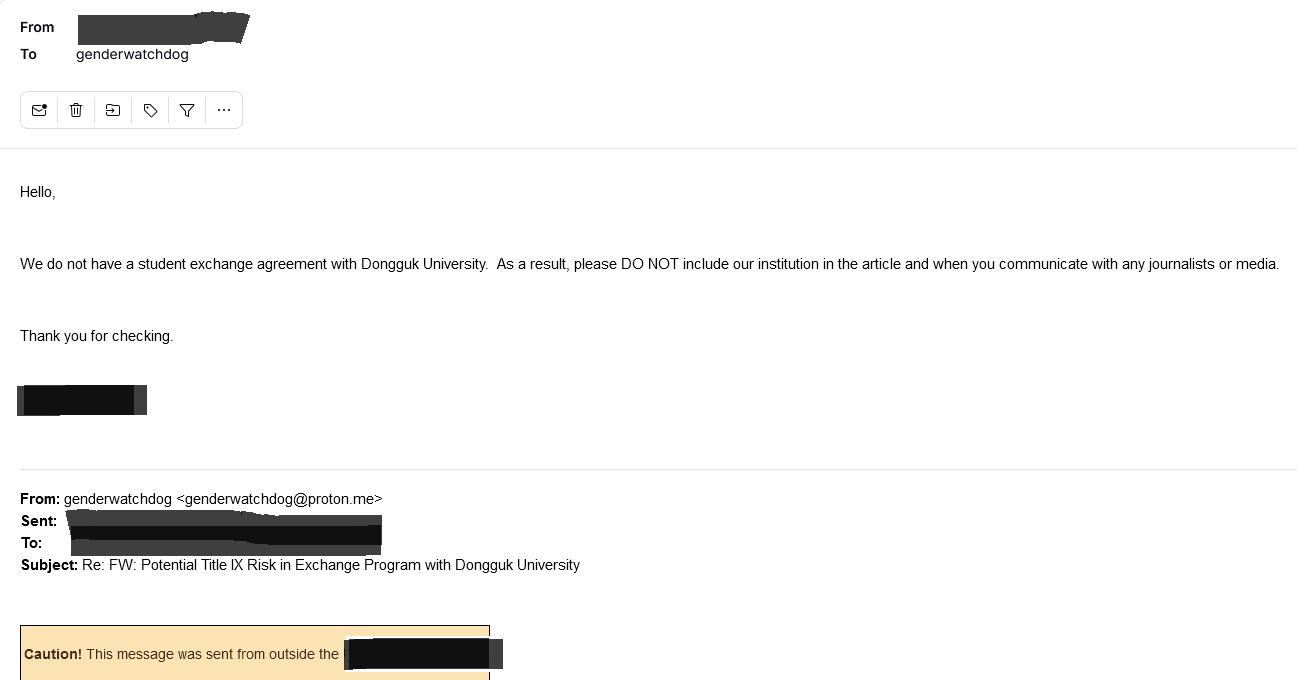
- A second Canadian university formally denied any partnership with Dongguk in writing, requesting anonymity (Screenshot of email evidence: https://raw.githubusercontent.com/Gender-Watchdog/genderwatchdog_metookorea2025/refs/heads/master/imgs/partner-screenshots/email-response-canada-04082025.png)
- University of Southampton's FOI office (FOI F-25-0507) confirmed active contractual obligations for student safety in their Dongguk partnership agreement — obligations Gender Watchdog has formally called on Southampton to enforce given Dongguk's documented sexual violence crisis17
What Dongguk did instead of responding to any of it:
Made three coordinated changes to its faculty roster on a Wednesday morning, eight days after the highest-profile Korea-EU research meeting of the year, while automated monitoring infrastructure was watching.
All were caught.
Gender Watchdog is supported by End Rape On Campus (EROC).
Follow the evidence: https://x.com/Gender_Watchdog
Sources
-
EU Delegation to South Korea, "EU-Korea Research and Innovation Day 2026" (March 24, 2026). https://www.eeas.europa.eu/delegations/south-korea/event-eu-korea-research-and-innovation-day-2026-24-march_en ↩ ↩2
-
Rainer Wessely, Counsellor for Digital and Research, EU Delegation to the Republic of Korea — email to Gender Watchdog (March 19, 2026). On file with Gender Watchdog. ↩ ↩2 ↩3 ↩4 ↩5
-
Visual Ping, diff capture, Dongguk DIC faculty page (April 1, 2026). https://visualping.io/diff/984971310?disableId=9yNDjbXqv0l6Dtn ↩ ↩2
-
Dongguk University, Graduate School of Digital Image & Contents (동국대학교 영상대학원) — faculty list. https://dic.dongguk.edu/professor/list?professor_haggwa_type=PROFH_088 ↩
-
Wayback Machine archive of Dongguk University DIC faculty page (captured April 1, 2026, 22:40 UTC). https://web.archive.org/web/20260401224055/https://dic.dongguk.edu/professor/list?professor_haggwa_type=PROFH_088 ↩ ↩2 ↩3
-
Gender Watchdog, "GEP Theatre and the Unguarded Gate: Dongguk Filed a Hollow Form; Chung-Ang Has Horizon Europe's NCP Role and No Form at All" (March 18, 2026). https://blog.genderwatchdog.org/gep-theatre-dongguk-chung-ang-horizon-europe-unguarded-gate/ ↩ ↩2
-
Wayback Machine archive of Dongguk University Graduate School of Digital Image & Contents English-language faculty page (captured April 2, 2026). https://web.archive.org/web/20260402004909/https://www.dongguk.edu/eng/dandae/122# ↩ ↩2
-
Wayback Machine archive of Dongguk University DIC faculty page (captured July 25, 2025 — confirms 차승재 listed as 교수 prior to purge; also shows 손민영 as continuing 연구초빙교수). https://web.archive.org/web/20250725004358/https://dic.dongguk.edu/professor/list?professor_haggwa_type=PROFH_088 ↩
-
Gender Watchdog, "Sidus Legal Threat Backfires: Evidence of Corporate Panic and Institutional Cover-Up at Dongguk University" (May 2025). https://blog.genderwatchdog.org/sidus-legal-threat-backfires-evidence-of-corporate-panic-and-institutional-cover-up-at-dongguk-university/ ↩
-
Gender Watchdog, "Viral Xiaohongshu Post Exposes Dongguk University Sexual Violence Crisis: Victims Break Their Silence" (May 2025). https://blog.genderwatchdog.org/viral-xiaohongshu-post-exposes-dongguk-university-sexual-violence-crisis-victims-break-their-silence/ ↩
-
Xiaohongshu post, "韩检警通报:东国大学合作造假性暴力危机" (May 2025). https://www.xiaohongshu.com/explore/68314964000000002300c6ca ↩
-
Korean Women's Development Institute (KWDI), Sexual Violence in Korean University Arts and Culture Programs (2020). Cited and analysed in: Gender Watchdog, "GEP Theatre and the Unguarded Gate" (2026). https://blog.genderwatchdog.org/gep-theatre-dongguk-chung-ang-horizon-europe-unguarded-gate/ ↩ ↩2 ↩3
-
Gender Watchdog (@Gender_Watchdog), "June 16, 2025: Canadian diplomat acknowledged our documentation of Korean university institutional failures as a 'sensitive matter.'" X post (October 31, 2025). https://twitter.com/Gender_Watchdog/status/1984263771922301125 ↩
-
Korean Prosecutors Notification Email, "제목: 형사 고발: 동국대학교의 국제 파트너십 위조, 공공 자금 오용 및 성폭력 은폐 혐의" (May 21, 2025). https://github.com/Gender-Watchdog/genderwatchdog_metookorea2025/blob/master/email_emls/korean-prosecutor-outreach/%EC%A0%9C%EB%AA%A9%20%ED%98%95%EC%82%AC%20%EA%B3%A0%EB%B0%9C%20%EB%8F%99%EA%B5%AD%EB%8C%80%ED%95%99%EA%B5%90%EC%9D%98%20%EA%B5%AD%EC%A0%9C%20%ED%8C%8C%ED%8A%B8%EB%84%88%EC%8B%AD%20%EC%9C%84%EC%A1%B0%2C%20%EA%B3%B5%EA%B3%B5%20%EC%9E%90%EA%B8%88%20%EC%98%A4%EC%9A%A9%20%EB%B0%8F%20%EC%84%B1%ED%8F%AD%EB%A0%A5%20%EC%9D%80%ED%8F%90%20%ED%98%90%EC%9D%98%202025-05-21T02_53_27-04_00.eml ↩
-
Gender Watchdog, "Global Fraud Alert: 3 Confirmed False Partnerships Expose Dongguk University's 'House of Cards'" (December 23, 2025). https://blog.genderwatchdog.org/global-fraud-alert-3-confirmed-false-partnerships-expose-dongguk-universitys-house-of-cards/ ↩
-
Gender Watchdog, "The 'Panic Scrub': Dongguk University Deletes UBC Partners, Reverts to 'Dead Names' in Failed Cover-Up" (January 19, 2026). https://blog.genderwatchdog.org/panic-scrub-dongguk-deletes-ubc-reverts-to-dead-names/ ↩
-
Gender Watchdog (@Gender_Watchdog), "CORRECTION: FOI F-25-0507 confirms a 'limited-scope' agreement exists (<5 students/yr)… Southampton confirmed 'explicit contractual obligations' for student safety." X post (January 7, 2026). https://twitter.com/Gender_Watchdog/status/2008942085542694959 ↩